Vegan Brown Rice Risotto with Sunchokes (Jerusalem Artichokes)


IMGP0003So I got a bag full of “Jerusalem artichokes” (lucky me that I married into a family of horticulturists), and didn’t really know what to do with them (or what they were in the first place). Had someone told me that they are what we call in Germany “Topinambur”, I would have known that it is that miracle vegetable that they sell in Europe in small capsules to promote satiety, stabilise blood sugar, get your digestion going, and, yup, lose weight (don’t think my in-laws knew all that when they planted them!). A bit of research on my side revealed that these unsightly tubers, which, according to my husband, “smell like dirt”, neither originate from Jerusalem nor are they artichokes, but in fact, they belong to the family of sunflowers, and their Italian name “girasol articiocca” (sunflower artichoke) was spoofed by the English and became “Jerusalem artichoke”. I’ll use their alias “sunchokes” here as it’s shorter and saves me time, lazy me! (And with winter approaching, you can never have too many reminders of the sun).

Now I don’t know if you’ll really lose weight with these bulbs, but they are certainly delicious and satisfying, and my favourite way to consume them is to roast them in the oven, smothered in good olive oil – you don’t even need to use salt (and when I say that, that means something!!!). Now, because roasted vegetable is not really a recipe, and because I needed to improvise a dinner, and because I had brown rice to use up (I know brown rice has come under quite some criticism lately, but I had it and I am still here), I came up with an easy and frugal and, yup, delicious way to use up sunchokes and brown rice, so if you ever find yourself in the situation of having to use up Jerusalem artichokes and brown rice, here I come to your rescue!

I don’t know how I thought of the combination of risotto/sunchoke, it just came up to me,l but a quick internet search revealed that I wasn’t the first one to think it up, only the first one to make that whole thing vegan. In fact, the tubers add a lovely tang to the risotto, which is a great thing, given the minimalistic amount of spices that I use. They are also a great substitute for mushrooms, which are usually a staple for our risottos (though feel free to add them as well). I’ll also show you that a “vegan” risotto is just as delish as the classic version, and you don’t even need Arborio rice or stock! What, no stock??? Yes, that’s right. I actually don’t stock stock (pun intended), as it is such a hassle to make your own, but the store-bought versions always have junk in them (even if they claim they do not), so yes, I mostly cook without stock, heretic that I am, and it turns out every bit just as good! (I also cook mainly without garlic and onion, but that’s a different story.)

So what did I use then instead of stock? Water and wine – my two favourite drinks apart from coffee, but making risotto with coffee seemed a bit too experimental for me. Oh yes, I had white wine to use up too, so if you need to get rid of your sunchokes, brown rice, and white wine, here we go!!!

Serves 6

2-3 handfuls (or thereabouts) of sunchokes, washed well and cut into 2cm pieces (no need to take off the skins, but you are welcome to)
400 g brown rice
olive oil
salt and pepper
500ml water
500 ml white wine
tamari
100ml coconut milk plus more to serve
coconut oil

First, boil the rice in approx. 1,5 l of salted water until all water is absorbed and the rice is al dente (this should take 10-15 minutes). Heat enough olive oil in a Dutch oven or deep heavy skillet to cover the bottom. Add the par-boiled rice and stir until rice is covered with oil. Add 250 ml wine and wait until all wine is absorbed, stirring occasionally. Then add 250 ml water and wait till all is absorbed, 250 ml wine, and then again 250 ml water. Add plenty of tamari (you need the tamari to substitute the flavours of the stock). Add salt and pepper.

Meanwhile, cook the sunchoke pieces in olive oil or coconut oil until tender, about 10 minutes (you can also par-boil them in the microwave). Add the coconut milk and let bubble until the milk reduces and the sunchokes seem velvety. Mash like potato mash and stir into the risotto.

Let the risotto simmer for a few more minutes, and add some more coconut milk and coconut oil for that creamy richness that we love about risotto.

Enjoy!

Low Fat Gluten Free Baked Falafel

Falafel - gluten free, vegan, and low fat!
Falafel – gluten free, vegan, and low fat!

Before Sushi took rank 1 as my favourite food in my late twenties, it was undeniably falafel – and still is, actually. Especially since it is a bit easier to replicate at home than sushi! I love, love, loooooove falafel! Have I mentioned that I am in love with falafel? It is just one of those dishes that makes you think “who the eff needs meat”? Don’t get me wrong, I love meat! But falafel makes lving without a lot easier since it is just so delicious! To me, it is the perfect summer dish with fresh salad, a crispy gluten free pita, homemade hummus, and a glass of dry and ice-cold white wine. Falafel is also very good for you! Chickpeas provide protein, fibre, manganese, iron, and complex carbs, making you feel full for a long time! Chickpeas are also naturally low in fat, so one more reason to dig into those falafels – provided you don’t eat the conventional deep-fried version, which nullifies all the health benefits of the falafels.

Since I adore falafel but don’t believe in deep-frying (especially not deep-fried in recycled trans-fats, yikes!), I wanted to come up with a way to have them oven-baked, not fried. I am happy to announce that it worked! Falafel is naturally meant to be a rather dry dish, so in my view, it doesn’t really matter that the baked falafels might be a little bit drier than the store-bought ones. I think they are just as yummy, and if them being low-fat means that I can have more, I don’t complain either! I prefer not to use any oils besides olive oil and coconut oil; however, olive oil is not suitable for deep-frying, and neither is coconut oil, plus its flavour simply doesn’t work in middle eastern cuisine. So that’s why my falafels are baked!

Another issue is that falafel in a snackbar are most of the time glutenated as they contain wheat flour – a big, big no-no! So that’s why my falafel has chickpea flour, which makes a whole lot more sense as it improves the flavour a lot and naturally enhances the chickpea aroma. One more thing, please do not waste your money on those ready falafel mixes – there is nothing wrong with them per se, but they are basically just chickpea flour with a bit of salt and spices in them. They are chickpea pancakes and have absolutely nothing to do with falafel, no matter what the package says, and they are far too overpriced for what you get. If you want quick and instant falafel-style patties, just mix some chickpea (besan, garbanzo) flour with hot water, lemon juice, salt, and parsley and fry it, which makes for a filling and quick dish, but is simply not falafel! Again, you can make “falafel” patties by buying your own chickpea flour instead of expensive “falafel” mixes!

Which takes me to the second point – even though falafel is relatively easy to make, you have to start one day before you eat them – that’s because you need to soak dried chickpeas over night. Yes, you read right, unlike hummus for which we use canned chickpeas, falafel requires the dried chickpeas, which are half the size of the canned ones. Believe me – don’t try this recipe with canned chickpeas. I don’t say that it’s not delicious, but it’s just not the same! You really need to use the dried chickpeas!

This recipe is adapted from the Shiksa in the Kitchen, but I obviously don’t deep-fry the falafels, since this is a recipe for baked falafel – duh! There is another superb recipe in Yotam Ottolenghi and Sami Tamimi’s book Jerusalem, which recommends using a meat grinder.

Makes 30 falafels

375 g dried chickpeas, soaked overnight in a big bowl, covered in water twice their volume (or so that 5 cm water are above the chickpeas in the bowl)
1 onion, chopped (omit if low FODMAP)
1 garlic clove (omit if low FODMAP)
3 tbsp coriander, chopped
2 tbsp parsley, fresh, chopped
2 tbsp chickpea flour
1 tsp cumin
1,5 tsp salt
1 tsp ground coriander
generous grind of black pepper
generous pinch of cayenne pepper
pinch of ground cardamom
1/2 tsp baking soda (optional)

Drain and rinse chickpeas well. Process with all ingredients bar the baking soda to a coarse paste. Do not overprocess it! Scrape the sides down while you are processing it. It should more look like couscous than a paste, but it must still hold together! Place in a big bowl and fluff with a fork to smash any chickpeas that are not processed. Chill mix for 1 hour before using. If you are using baking soda, use it right before baking. You can omit it, but the falafels do get fluffier with the soda.

Preheat the oven to 210 °C and line a baking tray with baking paper (or use a silicon sheet). With wet hands, shape balls or patties out of 2 heaped tablespoons of the falafel mix. Bake for 30 minutes in total, turning around half way through until lightly golden. Serve with gluten free pita, salad, hummus, and tzatziki.

Tip: It’s great to toss the falafels in a bit of sesame before baking!

Enjoy!

Spinach, Watercress, Cucumber and Mint Salad

Healthy, delicious summer salad

It’s been hot in Melbourne the last days – extremely hot. The mercury has climbed to up to 44 °C, and it doesn’t want to budge! Now, when I said I was ready for summer, I certainly wasn’t expecting this! Come back, rain, I didn’t mean the things I said to you! Luckily, days like these are still the exception for finicky Melbourne weather, at least for several days in a row. But how to stay nice and cool when outside is a furnace and inside doesn’t have air con?

While hot weather like this makes your New Year’s resolutions to eat lighter easy, it is not always easy to decide what to eat on such a day. You usually don’t feel like much, but still, you need to live and provide your body the nutrients it loses while sweating!

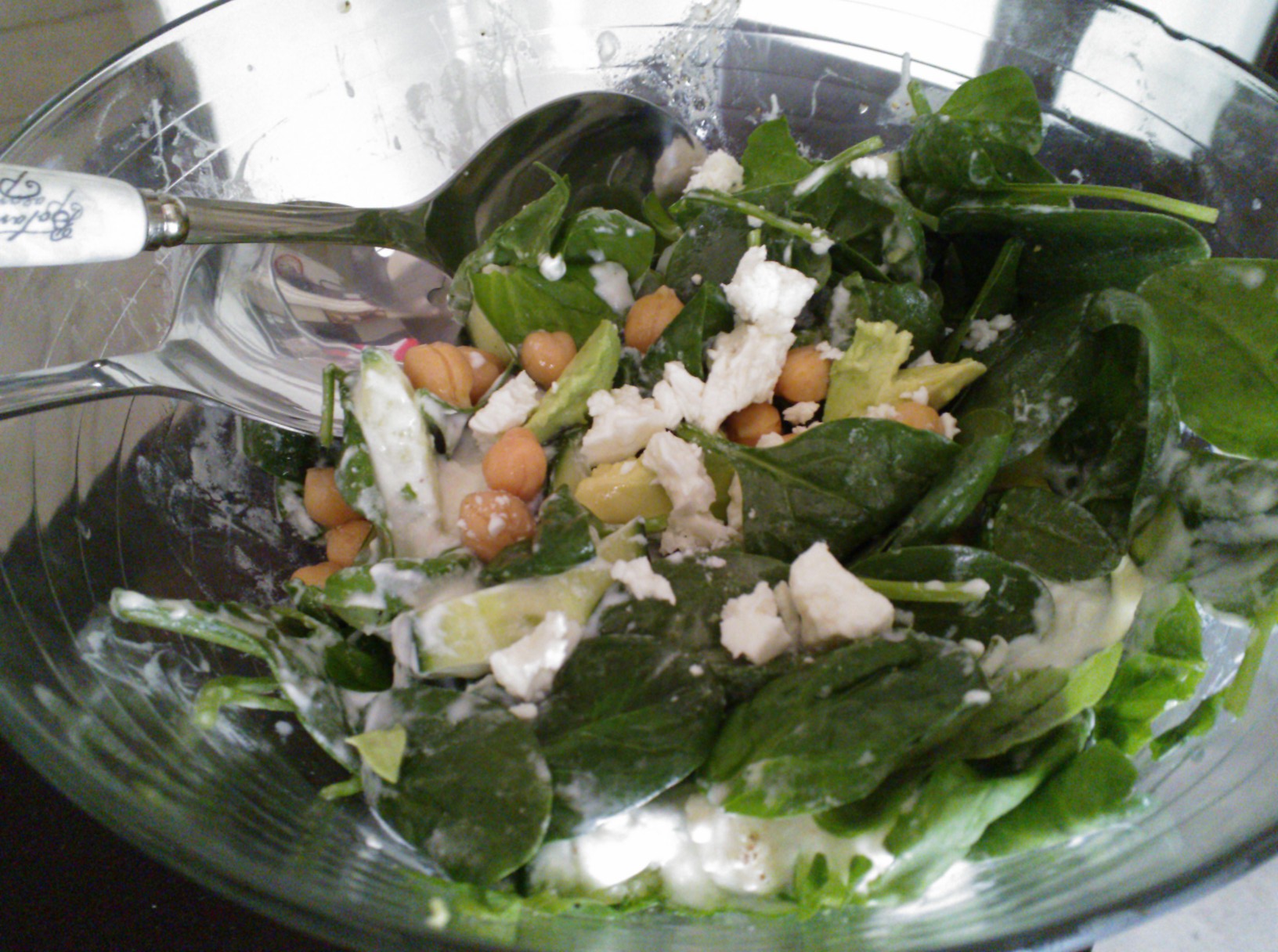
The solution to this dilemma? My perfect cool summer salad – just right on days like this (or even just about any time of the year)! It is light and refreshing while filling, nutritious and wholesome! Spinach, watercress and cucumber provide vital micronutrients and fluids, while there’s protein for satiety from goat yoghurt and sheep’s cheese, complex carbs from chickpeas to get you through the day, and healthy fats from olives and avocado – now, if that doesn’t sound like it’s great for you! Moreover, this is also one of the most delicious salads I have ever experimented with! While the combination of cucumber, yoghurt and lemon is great by itself, fresh herbs from the garden like mint, basil, and parsley just take the flavour to the top!

Serves 2

1 large cucumber, washed and cubed
100 g spinach, silverbeet or kale, washed and roughly chopped
2 handfulls of watercress, washed and roughly chopped
1/2 Hass avocado, cubed
10 olives
2 tbsp chickpeas
60 g fetta or chèvre
250 g goat or sheep yoghurt, strained
2 tbsp extra virgin olive oil
2 tbsp lemon juice
salt and pepper
parsley, basil and mint to taste

Prepare the dressing in a large bowl out of yoghurt, oil, lemon juice, herbs and spices. Add cucumber, spinach, cress, olives, chickpeas and mix well. Finally, add the avocado and crumble the cheese on top.

Enjoy!


Ultimate Detox Soup

Do you have new year’s resolutions? Well, my hubby’s is to learn German (which is a very good resolution), I want to become a better baker in 2014, and chances are, you plan to eat healthier or make more home-cooked stuff instead of takeaways – in which case you have come to the right place!

Actually, the title is a little bit confusing – the soup we’re dealing with here is far from a tasteless broth fasting. In fact, it is a warming, hearty, thick, stew-like soup, which is very comforting on cold winter days (as they are now in the Northern Hemisphere), and at the same time, it is the perfect light soup to give your digestive system a break, reset your taste buds and gain back the energy you lost in a holiday-carbohydrate-induced stupor (and maybe lose a couple of pounds, too!).

The good thing is, my magical soup doesn’t taste like anything that resembles the words “diet” or “detox”, but it is pure goodness in a bowl, consisting of nothing but fresh vegetables, water, a dash of olive oil, lemon juice, and a few spices. There is no stock powder, no MSG, no unhealthy fats, no sugar whatsoever, and only minimal amounts of coarse sea salt.

It really is the easiest thing to do – just shovel all ingredients in a stock pot and simmer for 45 minutes. It is the ideal way to make use of any leftover veggies that are withering in your fridge. No excuse to throw away any food anymore! (I hate wasting food.) It is a very inexpensive pleasure, too (if you buy your veggies from the market). And you can adjust the flavour to your liking – use any veggies you like (or which need to go), use herbs and spices (I love spicy food, so I use liberal amounts of chili powder – very good for your metabolism -, paprika, black and red pepper, ginger, cardamom, coriander, nutmeg, you name it). You can use curry powder and a dash of coconut milk for an exotic flavour. Or you can just keep it basic with s+p, garlic, chives, and parsley. Or make it Mediterranean style with crushed tomatoes, basil, and oregano (and a bit of shredded Parmesan). The options are endless.

In taste and texture, this soup resembles a classic pea and ham soup – only far, far healthier! So, chances are, your family will love it too! I sometimes add a bit of protein such as marinated tofu or tempeh. It’s all yours to make this your personal detox soup.

The Ultimate Detox Soup

Serves 6

1 kg fresh vegetables (e.g. leeks, carrots, cauliflower, broccoli, lettuce, parsnips, turnips, peas, green beans, tomatoes, zucchini, mushrooms, celeriac, pumpkin, capsicum, squash…)
water to cover
herbs and spices (salt, pepper, paprika, chili, ginger, cardamom, coriander, nutmeg, oregano, parsley, basil, chives…)
extra virgin olive oil to taste
lemon juice to taste
any add-ons to serve (e.g. tofu, tempeh…)

Rinse, drain, and chop the veggies into 1-inch pieces. Place on the bottom of a heavy stock pot and cover with enough water. Bring to the boil, add herbs, spices, EVOO, and lemon juice, and simmer uncovered for 45-55 minutes. Take off the heat and purée with a stick blender. Serve by itself or with a protein add-on and fresh parsley.

Enjoy!


Gluten Free Yeast Free Wholegrain Pizza Base (Vegan)

The good thing about experimenting is – even though it doesn’t always work, or, in fact, more often works NOT, you may stumble upon fantastic things you hadn’t imagined before. Take pita bread, for instance. I love falafel, just like anything else that belongs to Middle Eastern cuisine, and what is falafel without pita? So I tried to make pita – still working on it. My first tries were delicious enough, but they were not exactly pita, not enough pita to post a recipe on the web, anyway. However – my thought was “this would actually make quite a nice pizza”. Pita, pizza – the names are close enough, so I thought why not turn my pita experiment that didn’t work into a pizza experiment that works?

I must admit, pizza is one of the few things I genuinely miss being gluten free (having an Italian husband doesn’t help the cause!). Sometimes I would just like being lazy and grab one of these gluten-free pizza bases from the shop – a look at the ingredients (and nutrition facts) has so far been enough to deter me from wasting seven bucks on a processed gluten-free pizza base. Good on me!

It’s not that there is a lack of recipes for gluten free pizza out there, and I don’t doubt that they taste alright. But I just couldn’t find one that ticked all the boxes. Either they involved almond and/or coconut flour – and, as much as I like these two, almond and coconut just doesn’t belong on pizza! Or the recipes involved yeast and/or gums (a big no-no), or they seemed to be too complicated and involving too much time when you are hungry and impatient! I wanted a pizza recipe that doesn’t need proofing. I am not the biggest fan of a yeasty taste either, and I find it quite hard on the stomach which is not healthy.

This pizza is also WHOLEGRAIN – so it is really good for you. There is no complicated ingredients (you should have these when you have been baking gluten free), and if you get started right now, you could have a lovely healthy gluten free pizza that is delicious in less than 30 minutes. WTF? Exactly. My wholegrain pizza base ticks all the boxes. You can make this for your gluten-eating friends, and they won’t say “this is good for gluten free”, they will say “this is good”. In fact, I trust they will say “this is great”. Healthy? Tick. Easy? Tick. Yummy? You bet. And quicker than waiting for takeaway.

Gluten Free Vegan Pizza Base

Makes one baking sheet of pizza (probably makes sense to double or triple using several sheets and freeze leftovers)

50 g buckwheat flour
50 g brown rice flour
30 g millet or oat flour
30 g ground flax seeds
1,5 tsp sea salt
1 tsp baking soda
3 tsp vinegar
1 tbsp olive oil
a pinch of sugar (or honey)
225 ml warm water
garlic powder (optional)
tomato paste (optional)
oregano
olive oil to top (optional)
toppings to taste

Preheat oven to 220 ° C. As usual, mix the dry ingredients (flours, soda, salt, flax, sugar, garlic powder if using) until one colour. Add water, oil and vinegar and mix until you have a supple, uniform dough – a bit like a muffin batter, rather than the pizza doughs you might have made with gluten flour. Let the dough rest for 10 to 15 minutes before spreading it on a very well-greased or silicon baking sheet – the thinner you spread it the better. After all, we want a nice Italian-style thin crust pizza, not one of these American grease bombs which are as thick as a quilt! With a wet spatula or spoon (or using your wet/oiled hands), flatten the dough so that it becomes nice and even. We don’t want a pizza that is thin in one corner and thick and doughy in the other!

Bake the dough without toppings for roughly 15 minutes until dry and pizza-like. Now comes the fun part – the toppings. You will probably want to spread some tomato paste and oregano on the pizza as a classic, although this is not even necessary. For the pizza in the picture, I used a mix of different vegetables (kale, peas, fresh tomatoes, mushrooms, capers) and some tempeh as vegan “ham”. Olives, sundried tomatoes and vegan cheese would also be a great additionI Just try whatever you fancy! I recommend sprinkling the top with a dash of olive oil, which works wonders for the flavour!

Now bake the pizza base with the toppings until they have reached the consistency you desire – probably another 10, 15 minutes. Devour.

Enjoy!